Everyday Object Doodles: 33 Hand-Drawn Assets for Makers
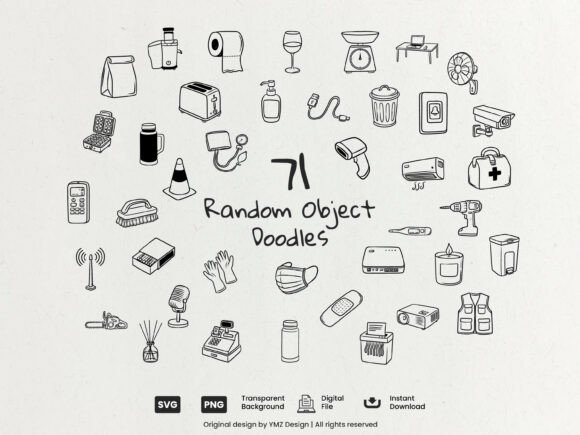
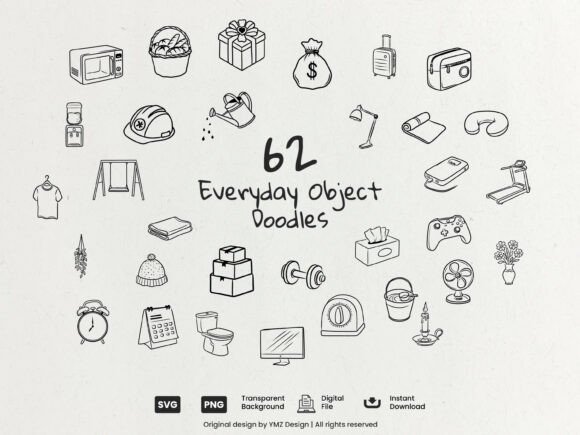
There is a specific kind of magic in a hand-drawn line. It breathes, it wobbles slightly, and it carries the warmth of a human touch that vector-perfect geometry often lacks. For designers, marketers, and content creators, capturing that "hand-made" essence without sacrificing professional quality is a constant balancing act. This is exactly where the Everyday Object Doodles Clip Art Bundle steps in. It is not just a collection of sketches; it is a curated library of 62 distinct, high-resolution illustrations designed to bridge the gap between artistic charm and commercial utility.
The Anatomy of Authentic Doodle Art
When you first open this bundle, the immediate appeal lies in its authenticity. These aren't sterile, auto-generated shapes. They are meticulously hand-drawn, embracing a traditional black and white aesthetic that feels familiar yet refined. The visual personality of this collection is best described as "organized chaos"—it has the spontaneity of a sketchbook margin but the clarity required for professional design assets. The high-contrast black ink pops against white space, making it incredibly versatile for various brand identity projects.
From a technical standpoint, the bundle is built for modern workflows. The inclusion of SVG vector files is a game-changer. Unlike raster images that pixelate when scaled, these vectors can be blown up to billboard size or shrunk down for a favicon without losing an ounce of crispness. Furthermore, the PNG files come with transparent backgrounds, eliminating the tedious masking process. Whether you are working on a massive print layout or a quick digital sticker, the 300 DPI resolution ensures that your web design or physical product looks impeccable.
Infusing Personality into Branding and Marketing
In a digital landscape saturated with polished, corporate aesthetics, a bit of imperfection can be a strategic advantage. The Everyday Object Doodles Clip Art Bundle offers a unique opportunity to soften a brand’s voice. If you are developing a logo design for a café, a stationery shop, or a lifestyle blog, incorporating these hand-drawn elements can instantly communicate approachability and creativity. It moves a brand away from looking "manufactured" and toward feeling "crafted."
Consider the impact on your social media graphics. Algorithms favor engagement, and users tend to pause their scrolling for content that feels human. Using these doodles as background elements, icons, or accent marks in your Instagram stories or Pinterest pins can break the visual monotony. They work beautifully as a creative font alternative for headers where you want to convey a casual, conversational tone. Instead of using a heavy display font, a hand-drawn heading paired with a clean sans serif font body text creates a dynamic visual hierarchy that guides the eye naturally.
Practical Applications: From Digital Planning to Packaging
The versatility of this collection allows it to shine across both digital and physical mediums. For the booming market of digital planning, these assets are gold. They serve as perfect embellishments for digital journals and planners, adding a tactile feel to an otherwise flat screen. For physical crafters, the applications are just as broad. Scrapbookers and card makers will find the high-resolution quality essential for printing crisp stickers and decals.
However, the utility extends far beyond personal hobbies. In packaging design, these doodles can be used to create intricate patterns that wrap around a box, or as spot illustrations on product labels. Imagine a tea brand using these sketches on their packaging to denote flavors—a doodle of a lemon for citrus, a leaf for green tea. It is a subtle way to use modern typography and illustration principles to enhance the unboxing experience.
Integrating Doodles into Editorial and Web Design
For publishers and bloggers, visual fatigue is a real problem. Long blocks of text, even with excellent serif font or sans serif font choices, can feel daunting. Integrating the Everyday Object Doodles Clip Art Bundle into your editorial design can act as a visual palate cleanser. Use them in the margins of a PDF newsletter or as section dividers on a blog post. They help maintain reader engagement by providing a visual break that keeps the energy light.
When testing font pairings, these doodles act as a neutral bridge. Because they are black and white, they do not clash with your color palette. They sit comfortably alongside a script font for a romantic vibe or a bold modern typography layout for a tech startup. The key is to treat them not just as decoration, but as part of your communication strategy. They can illustrate a point faster than text can explain it, improving the overall readability and flow of your content.
A Checklist for Implementation
- Evaluate the Context: Does the doodle style match the tone of your project? While perfect for lifestyle and creative niches, they might need to be used sparingly in strictly corporate financial reports.
- Mind the Scalability: Always use the SVG vector files when working in Adobe Illustrator or Affinity Designer to ensure infinite scalability.
- Check the Licensing: Ensure your specific use case—whether it is for a client's brand identity or a print-on-demand product—aligns with the commercial license provided.
- Layering Techniques: Experiment with opacity and layer modes in Photoshop. A doodle set to "Multiply" can look like a stamp, while one set to normal looks like a sticker.
Final Thoughts on Creative Assets
Ultimately, the Everyday Object Doodles Clip Art Bundle is more than just a download; it is a toolkit for adding personality. It allows content creators, marketers, and designers to bypass the time-consuming process of sketching from scratch while retaining that coveted hand-drawn aesthetic. Whether you are revamping a website, launching a new product line, or simply organizing your digital life, these illustrations provide the flexibility and quality needed to elevate your work from standard to standout. It is a reminder that in the world of graphic design, the best assets are often the ones that feel the most human.